
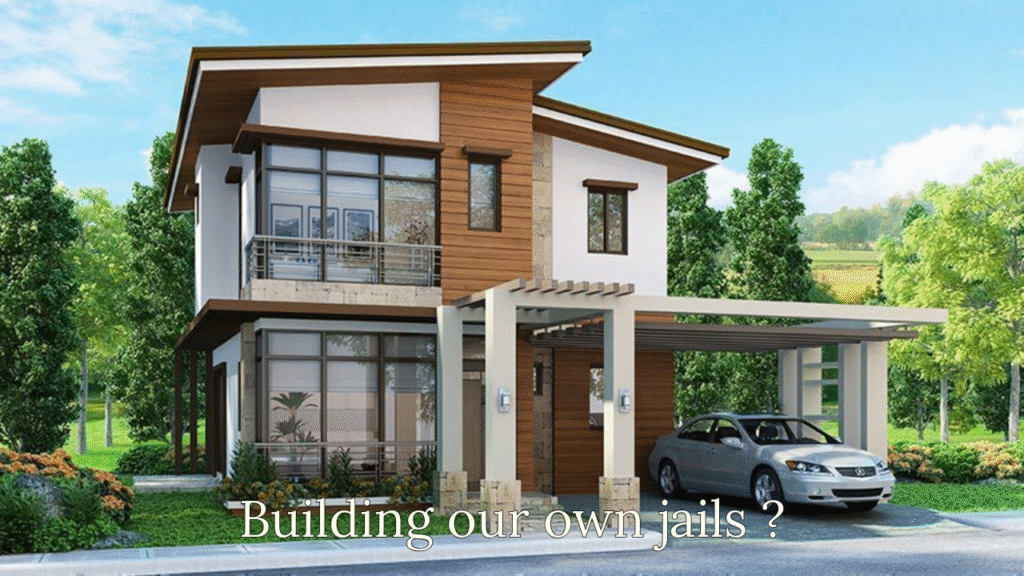
The Big House Dream
Drive through almost any part of Kerala and one pattern hits you immediately: houses everywhere.
Two‑storey villas with tiled roofs, decorative gates, granite steps and large sit‑outs, often with only one or two people living inside. For many Malayalees, especially those who have worked in the Gulf, a big house is the ultimate certificate of success.
But beneath this picture-perfect dream is a harder question:
Are we pouring our entire life’s effort into buildings that we hardly use, that keep us chained to EMIs, and that will one day turn into piles of debris?
This blog is an attempt to unpack that.
1. How Much of Kerala’s Wealth Is Sitting in Concrete?
What does it actually cost to build these houses?
In 2026, multiple Kerala-based cost guides put the average construction cost in the range of about ₹1,800–₹3,500 (or more) per square foot, depending on the quality of finishes and design complexity.
Typical estimates look like this:
- Basic / economy: around ₹1,800–₹2,200 per sq ft.
- Standard / mid‑range: roughly ₹2,200–₹2,800 per sq ft.
- Premium: often ₹2,800–₹3,500+ per sq ft, and luxury builds go even higher.
What does that mean in real numbers?
- A 1,000 sq ft “basic” house: roughly ₹18–21 lakh for construction alone.
- A 1,200 sq ft decent mid-range house: around ₹25–35 lakh (again, only construction, no land).
- A 2,000 sq ft standard house: easily ₹50–70 lakh in construction cost, and ₹80 lakh–₹1.5 crore+ after adding land, design, interiors, etc.
And most families don’t pay this from savings alone.
Home loan guides for Kerala show EMIs of about ₹750–₹900 per lakh per month, depending on the loan tenure and interest rate. A ₹50 lakh home loan can easily mean ₹40,000–₹45,000 per month in EMIs for years.
Where does the money come from?
Kerala’s economy is famously remittance-driven.
- In 2023, a major migration survey estimated ₹2.16 lakh crore of remittances flowing into the state from expatriates.
- Analyses in 2025–2026 show remittances contributing roughly 17–23 percent of Kerala’s state income, an extraordinarily high share compared to other Indian states (where the average is around 3 percent).
Studies on remittances and household spending patterns in Kerala find that as remittance income has grown, families have steadily shifted spending away from basic consumption towards housing, land, savings and debt repayment.
In other words:
When money comes from abroad, a big chunk of it goes into “our own house back home”.
For many families, this becomes the single biggest financial project of their life.
The house becomes not just a shelter, but the main container of their wealth, their status, and their identity.
And that is where the trap begins.
2. When Homes Turn Into Empty Shells
How many houses are actually vacant?
The paradox is this: while families pour huge amounts of money into houses, a shocking number of these homes are not really lived in.
Census-based and research reports indicate that:
- By 2011, about 10.6 percent of all census houses in Kerala were vacant.
- One detailed study estimates that this translated to roughly 11.9 lakh empty houses in the state.
- Media reports summarising census data noted that the growth in vacant houses was far higher than the growth in population, and that over 11 lakh houses were lying locked and vacant, even as they consumed huge amounts of sand, rock and water during construction.
Later policy analysis around the state’s K‑Homes scheme (which tries to convert empty houses into tourism infrastructure) points out that:
- Around 10.6 percent of census houses in Kerala are vacant, and
- About 60 percent of an estimated 12 lakh closed houses belong to non‑resident Keralites who have settled abroad.
So while ordinary Keralites are still told “house is the best investment,” a large part of the state’s housing stock is simply locked up, waiting for its owners to visit once in a while.
Who lives in these big houses?
On the ground, the story is familiar:
- Parents build or upgrade a large house using Gulf or other remittance money.
- Children study and work in Bengaluru, Mumbai, Hyderabad, Dubai, Toronto.
- Finally, only the elderly parents remain in the big house.
Research on Kerala’s housing conditions confirms that a significant portion of vacant or under-used houses are owned by better-off families and NRKs, not by the poorest households.
For older parents, maintaining a large RCC house and courtyard is a daily battle: cleaning, repairs, roof leaks, moss on steps, overgrown grass. The very thing that was supposed to give comfort in old age often becomes a physical and emotional burden.
3. Migration, Remittances and the “Orphaned House”
Kerala’s migration engine
Kerala’s migration story is well known, but its link to housing is sometimes ignored.
- Recent migration surveys show remittances to Kerala more than doubled between 2018 and 2023, rising from around ₹85,000 crore to over ₹2.16 lakh crore despite global shocks.
- In 2023, remittances were around 1.7 times the state’s total revenue receipts, underlining how deeply household and government finances depend on money earned abroad.
This money heavily fuels the housing boom. Studies of remittance-using households consistently find that building or improving the family home is one of the top uses of overseas income, alongside loan repayment and savings.
The life-cycle of a typical “Gulf house”
The pattern often looks like this:
- Migration & money
Someone in the family goes to the Gulf or another country, starts sending money home. Remittances grow steadily over a decade. - The big house project
The family’s first big goal is to build or expand a house in Kerala—sometimes far larger than what the household actually needs. - Children move away
Better education and opportunities pull the next generation to Indian metros or abroad. Entire families migrate permanently in many cases; one policy note linked to K-Homes mentions 4.2 lakh cases of family migration, where whole households have left, leaving houses locked. - Parents age in place
The original builders (parents) are now alone in a large house. Their world shrinks, but the house stays oversized. - Orphaned building
After the parents pass away or move in with children elsewhere, the house is locked most of the year. It becomes a holiday home, an investment, or simply an unresolved emotional asset.
The result: a huge stock of “orphaned houses”—expensive structures with no full-time life inside them.
If you zoom out, the picture is harsh:
Families sacrifice years of freedom and risk to build a house they hardly live in. The children, whose future this house was supposed to secure, often prefer to live elsewhere.
That is exactly how a dream home starts to resemble a self‑built jail.
4. The Future Problem: Demolition and Debris
How long do these concrete houses actually last?
Civil engineering references on Indian building practice commonly mention an expected economic life of around:
- 55 years for load‑bearing constructions, and
- Upwards of 70–75 years for well‑built RCC framed buildings—assuming proper design and regular maintenance.
Construction & demolition waste: a silent environmental crisis
Demolition is not just about knocking down walls. It creates a massive waste problem.
- National and pollution-control guidelines estimate that demolition can generate 300–500 kg of construction & demolition (C&D) waste per square metre of built-up area.
- Kerala has recognised this and amended its building rules (Section 79A) to make every permit-holder responsible for handling their C&D waste according to the Construction & Demolition Waste Management Rules.
- Standard Operating Procedures issued by Kerala’s Local Self-Government and Pollution Control Board require owners and contractors to transport debris to authorised facilities, pay treatment fees, and avoid dumping in waterbodies and public spaces.
Despite these rules, Kerala’s own solid waste management documents admit that illegal dumping and poor treatment of solid and C&D waste continue to create serious environmental and public health risks—clogged drains, flooding, degraded land and polluted water.
Now imagine the long-term impact if lakhs of RCC houses across Kerala—many large and structurally heavy—are gradually demolished over the next few decades without robust recycling and waste-processing systems.
5. Are We Building Homes or Self‑Made Jails?
A jail is a place where a person is confined and cannot walk out whenever he wants; he knows he is trapped, and that knowledge itself creates agony. In Kerala, the big house often plays a similar invisible role. Once a family has poured its entire life savings into one building, and taken a large home loan on top of it, they cannot easily move to a smaller home or a different city even if life or work demands it—EMIs of ₹40,000–₹50,000 a month for years effectively act as iron bars on their choices. Because so much money is locked into the house, they also lose the freedom to use that capital for better schooling, starting a business, travelling, or simply improving day‑to‑day comfort. Outwardly the house is big, but the actual standard of living—time, flexibility, joy—can be below average. To make it worse, after investing so much money and emotion, they become psychologically attached to this one structure and cannot even imagine living anywhere else. In that sense, the walls that imprison them are not just concrete; they are also made of sunk cost and emotional attachment.